
The ancient capital of Sri Lanka and the cradle of the Sinhalese culture, Anuradhapura is laden with numerous historic sites from its bygone era, something which makes it among the country’s most popular tourist destinations. As it is often the case, though, the city’s centuries-long fame outshines many other noteworthy places in its vicinity. One of which is Mihintale, a towering hill which according to the lore was the birthplace of Buddhism in the island.

By: Praveena Sukumaran
Date: 10:23 11.07.24
Last Update: 17:26 11.07.24
Established by King Pandukabhaya in 437 BC, the Anuradhapura Kingdom was the precursor of modern-day Sri Lanka, unifying much of the island under a single rule. Throughout its 1,454 years of existence, the kingdom transformed the island into an agricultural powerhouse, dotting the landscape with vast reservoirs and irrigation systems.
It was also during this period that the Sinhalese, Sri Lanka’s largest ethnic group, embraced the Buddhist faith, the island’s predominant religion to date. Though the origins of Sri Lankan Buddhism are steeped in mystery, a sole mountaintop 12 kilometers east of the kingdom’s eponymous capital city, proclaims to be the site where the teachings of Buddha were first introduced to the islanders.
Legend has it that in the 3rd century BC, the then king of Anuradhapura, Devanampiya Tissa, met here with a group of emissaries sent by Emperor Ashoka of Magadha, an ancient kingdom that thrived across the Indian subcontinent at that time. One of whom was Mahinda, Ashoka’s first-born son and a devoted Buddhist monk.
As the novice saw that Devanampiyatissa is poised to pierce a standing deer with his arrows, he uttered the king’s name and invited him for a conversation, during which he elaborated about the Buddhist faith and its peaceful message. After losing many of his compatriots to endless wars, Devanampiyatissa was urged by Mahinda to renounce violence and adopt the principles of his faith.
After this enlightening moment, the Anuradhapura king opted to convert to Buddhism, leading the entire Sinhalese nation to follow suit shortly thereafter.
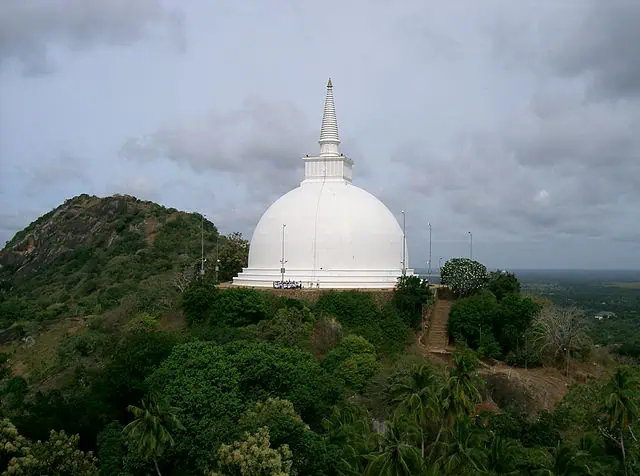
Maha Stupa
photography by: Sampath/ Wikimedia Commons
Ever since this prorupted rendezvous took place, Mihintale (translated as the plateau of Mihindu, the monk’s Sinhalese name) became a pilgrimage site where swarms of ardent believers huddle in search of divine inspiration. Scattered atop the hill are several ruins and religious structures, built piecemeal throughout the centuries, including an ivory-hued statue of Buddha, a massive stupa and even a couple of manmade ponds whose waters have been quenching the thirst of monks since ancient times.
Standing out for its intricate reliefs is Kantaka Cetiya, a circular stupa with a base circumference of about 130 meters. Representing the Four Noble Truths are the building’s four ornate Vaahalkadas (frontispieces) that face each cardinal direction, each of which is marked by a different sculpted animal – a horse in the west, a lion in the north, an ox in the south and an elephant in the east. Believed to have been built by King Suratissa and renovated by King Lajjitissa in the 1st century BC, the stupa’s well-preserved ruins now stand 12 meters tall.
Nevertheless, perhaps the single most important place throughout this hilltop complex is Ambasthala Dagaba, a white stupa girdled by tens of columns, a vestige of a house that once encased the dagaba. Within the stupa lie what according to some are the remains of Mahinda, though this has never been confirmed by anyone. Another unverified claim is that it was the location where the king and the young monk first conversed.
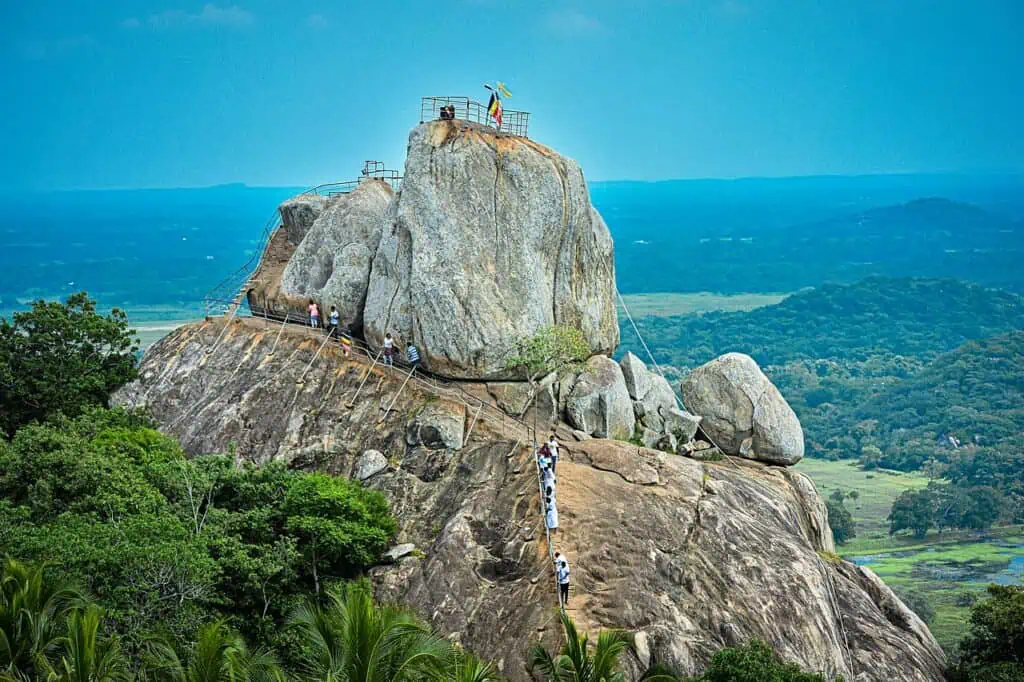
A second proponent for being their first meeting place is Aradhana Gala, a climbable granite rock that soars over the plateau. Tradition holds that Mahinda flew his way from India to Sri Lanka and landed directly on the upper part of the rock, where he met Devanampiyatissa. Steps carved out of the boulder provide access to the lookout at its top, where visitors are rewarded with sweeping views.
A far more energy-draining stairway, however, is the one connecting Mihintale with its surrounding grounds. Comprising 1840 granite steps, the stairway spans across the mount’s northern slope.