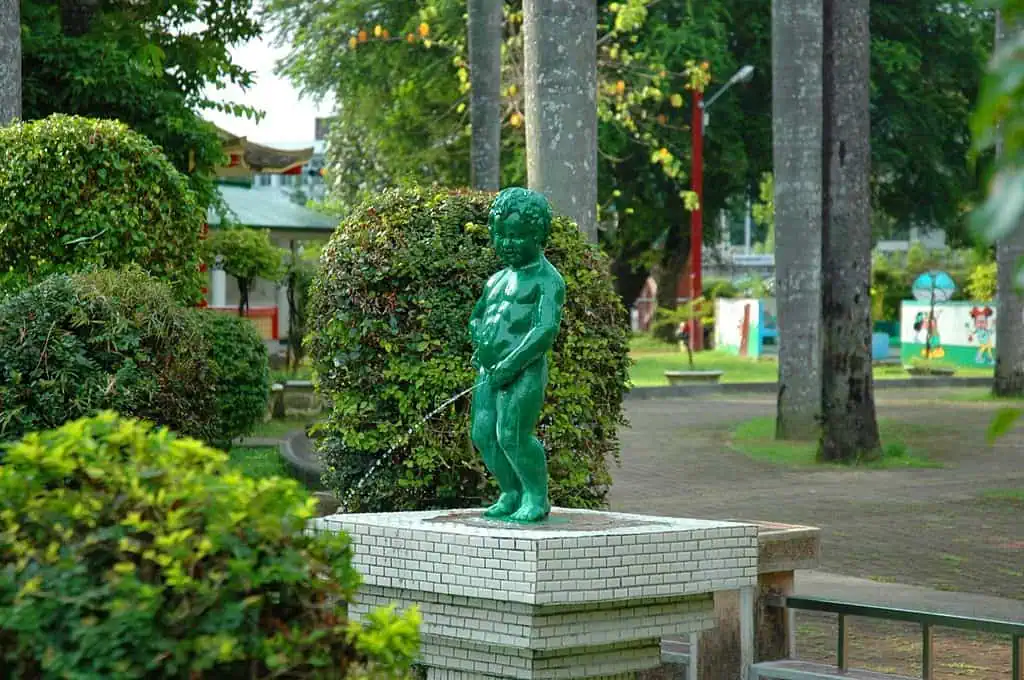
The Manneken Pis replica in Chiayi, Taiwan, as it looked before restoration
photography by: Niceplaza~commonswiki/ Wikimedia Commons

Among the world’s most famous statues, Manneken-Pis, Brussels’ urinating toddler, has been micturating faux-pee for centuries now. Despite its small size, the sculpture rapidly became the symbol of the city it calls home, a hefty position it still holds. Throughout the years, the whimsical figure became so popular that it now has dozens of replicas all over the planet, each of which bears an interesting story behind it.

By: Frank Skidmore
Date: 01:14 17.12.24
Last Update: 01:17 17.12.24
A mere 500 meters from Brussels’ famed urinating youngster lies another sculpture with a sensitive bladder, but with four legs instead of two. Standing mid-act, the bronze dog, aptly named Zinneke Pis, lifts its leg against a bollard. Created in 1999 by artist Tom Frantzen, the statue playfully mirrors the nearby Manneken Pis.
Unlike its muse, which is a fountain, Zinneke Pis is a static statue that exudes charm through its cheeky pose rather than flowing water. According to Frantzen, the name Zinneke, a local term meaning ‘mutt,’ reflects the sculpture’s tribute to the humor-filled folk culture of the Belgian capital, known locally as zwanze.
Apart from its humanoid counterpart, Zinneke Pis was also inspired by Frantzen’s own dog, lending the statue a personal touch. Standing at the intersection of Rue des Chartreux and Rue du Vieux Marché aux Grains, it has since become synonymous with one of the city’s trendiest neighborhoods.
While its history hasn’t been without mishaps, the sculpture has withstood the test of time. Vandalized in 2007 and struck by a car in 2015, it has been painstakingly restored on each occasion by the local community, which truly cherishes its charming quirkiness.

Manneken Pis’ four-legged counterpart
photography by: Arcadiuš/ Flickr
Located in the heart of Zagreb, Trg Petra Svačića is among the many green town squares that dot the Croatian capital and make it one of the Balkans’ most livable cities. At the center of this verdant plaza, a sculpted boy unabashedly takes a leak as if he hasn’t relieved himself for a day or so. His incessant stream of water is so strong that it has filled up the adjacent pond.
Created by artist Antun Augustinčić in 1957, the sculpture is entitled “The Boy“, though its more widely-known moniker is “The Boy Who Pees“. Following a series of recent repairments, it has become a local icon whose presence is impossible to ignore.

Zagreb’s Boy Who Pees
photography by: Suradnik13/ Wikimedia Commons
Tokyo’s railway network is renowned worldwide for its efficiency and extensive coverage. Therefore, it is no wonder that millions of Tokyoites rely on these trains daily, crowd the railcars and platforms as they commute to work, home, or elsewhere. Amid this hustle and bustle, a whimsical replica of Manneken Pis adorns platforms 3 and 4 of Hamamatsuchō Station.
Installed in 1952 as a gift from local dentist Hikaru Kobayashi, the Little Peeing Monk statue is modeled after its famous counterpart in Brussels, and yet, it has since gained a character all its own. Known in Japanese as Shōben-kōzō, which translates to “Little Peeing Boy”, the sculpture has become associated with the surrounding station, revered by passersby for its ever-changing wardrobe.
For over three decades, a dedicated group of volunteers, called Ajisai, has been designing and crafting the statue’s costumes, a tradition that began in 1986 when the local fire department requested a firefighter outfit as part of a safety campaign. Since then, the outfits have evolved to match seasonal events, cultural holidays, and even contemporary themes.
The costume change happens monthly, typically on the 26th, unless it falls on a weekend, in which case it’s rescheduled. Visitors can admire the statue garbed as Santa Claus in December, a firefighter in November and March, or even dressed for the Olympic Games. To see it, a valid train ticket is needed, as the statue is accessible only from within the station.

The Manneken-Pis replica at Tokyo’s Hamamatsuchō Station
photography by: Suradnik13/ Wikimedia Commons
As its name suggests, the Alsatian Manneken-Pis resides in Colmar, deep in the Alsace region of France. Gifted in 1922 to mark the fourth anniversary of the city’s liberation during World War I, this bronze figure is located on Rue des Augustins in Colmar’s historic center, close to the city’s high court. Unlike the original sculpture in Brussels, which functions as a fountain, the Alsatian version is purely decorative, devoid of any water flow.
The statue was originally created as a gesture of solidarity between Belgium and France, both of which shared wartime struggles multiple times. Initially placed in front of Colmar’s municipal baths, it was later relocated to its current whereabouts, where it baffles onlookers who might momentarily wonder whether they have been teleported to another place.
While for some, its inability to “pee” might be the only thing that sets it apart from its famed source of inspiration, it was first and foremost erected to honor those who paid the ultimate price for freedom rather than as a playful facsimile to gawk at.

Colmar’s Alsatian Manneken-Pis before and after restoration
photography by: Gzen92 and Anne Jea/ Wikimedia Commons
In the Danish town of Bogense, on the island of Fyn, stands a replica of the Manneken Pis whose story carries an unusual twist. This small bronze statue, depicting a boy cheerfully relieving himself, was donated in 1934 by Consul Willum Foenss, a prominent figure in town. According to the lore, Foenss was an orphaned infant found on a ferry near Bogense, adopted, and then raised by a foster family.
In reality, however, Foenss was the grandson of a local butcher. Born out of wedlock, he was sent to live with his grandparents but grew up in a happy, nurturing home. As an adult, Foenss became a successful businessman and diplomat. Wishing to honor his hometown and its people, he gifted the statue, along with other artworks, as tokens of appreciation.
Despite initial backlash from those who found the statue’s candidness controversial, it has become a proud symbol of Bogense. Much like its Belgian counterpart, on special occasions, the Danish Manneken Pis is dressed in various flamboyant attires.
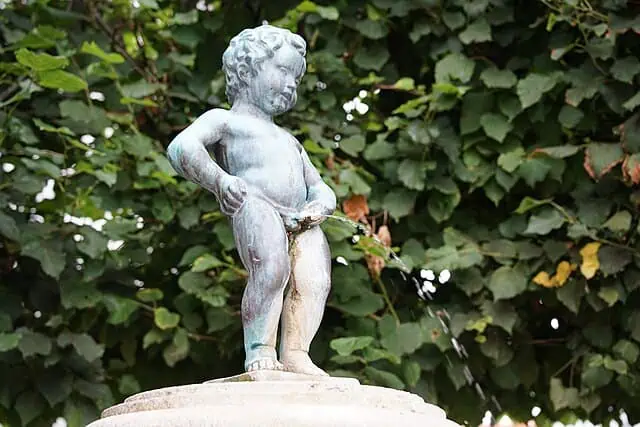
The urinating replica in Bogense, Denmark
photography by: Jck/ Wikimedia Commons
Ensconced on a small traffic island in Rio de Janeiro is Brazil’s own version of Manneken Pis, locally known as Manequinho. Created in 1908 by sculptor Belmiro de Almeida, the statue is nearly twice the size of the one in Brussels, boasting a disproportionately large head. Unlike its famous sibling, Manequinho uses solely his right hand to relieve himself, rather than both of his arms.
Manequinho originally stood in Praça Floriano but was relocated in 1927 to Botafogo Beach after public outcry over its perceived indecency. Over time, the statue became synonymous with the Botafogo soccer team. In fact, during the team’s state championship victory in 1957, a supporter draped Manequinho in the club’s black-and-white jersey, and kickstarted a tradition that cemented the statue as the team’s unofficial mascot. Since then, Manequinho has been dressed in celebration each time Botafogo triumphs.
Manequinho’s history has not been without hardships though. Stolen and disfigured in 1990, the statue was recreated in 1993 using the original mold and moved to its current location outside the General Severiano Palace, Botafogo’s headquarters. Vandalism struck again in 2008, but the statue was swiftly restored again, with the club taking responsibility for its upkeep.

Manequinho in Rio de Janeiro
photography by: Omri Westmark
Roughly 10,000 kilometers away from the Belgian capital, Chiayi Park in Taiwan features its own reproduction of Manneken Pis. It was installed in 1935 during the Taiwan Exposition, which marked the 40th year of Japanese colonial rule over the island. Intriguingly, Belgium is believed to have donated two statues to Chiayi that year, although the whereabouts of the second statue remain unknown to this day.
Unlike its Belgian counterpart, the Chiayi statue is 90 centimeters tall, 30 centimeters taller than the original, and is made entirely of copper. Its exact origin puzzled locals for years, something which prompted a full-fledged investigation by the authorities. Despite its mysterious past, the statue has become a nostalgic emblem for many residents of Chiayi.
As evident, in 2002, it was awarded honorary citizen status by the Chiayi Humanistic Care Association. During the same year, a local elementary school student expressed a heartfelt wish for the statue to remain a permanent part of Chiayi Park.
Though debates have arisen over its place in Chiayi’s local identity and urban marketing efforts, the Chiayi Manneken Pis has remained an eccentric symbol of the city. Having endured years of aging, during which its bronze finish developed a turquoise patina, the statue was beautifully restored to its original glory in the early 2020s.
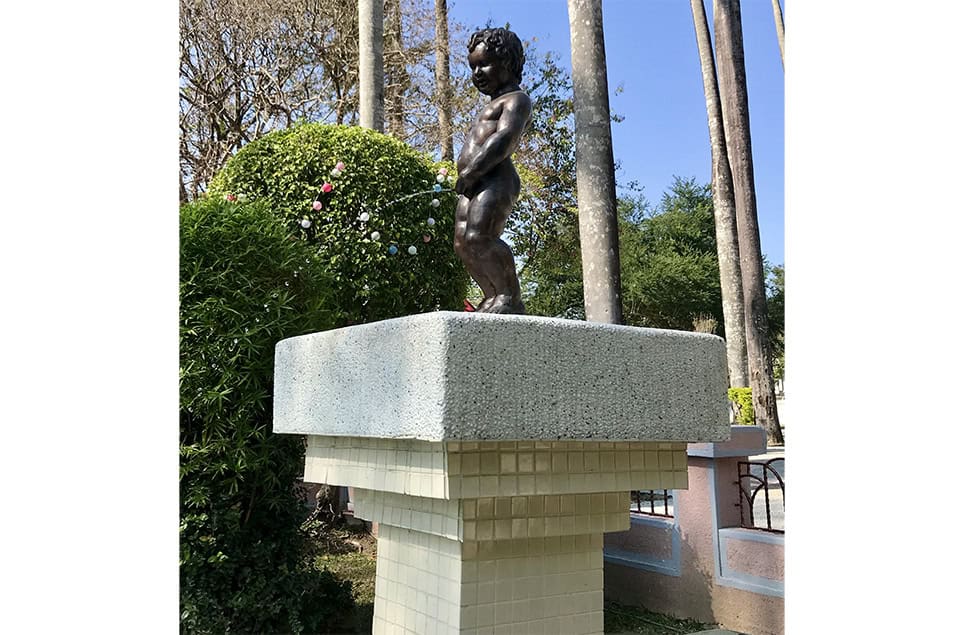
Chiayi’s Manneken Pis
photography by: Outlookxp/ Wikimedia Commons
Tucked away in an unassuming cul-de-sac in Brussels, Jeanneke Pis is the whimsical, female twin of the city’s iconic Manneken Pis. Unveiled in 1987 and designed by Denis-Adrien Debouvrie, this 50-centimeter bronze statue depicts a young girl with neatly tied braids, caught mid-squat as she empties her seemingly infinite bladder into the basin below.
The statue’s location, Impasse de la Fidélité, was chosen deliberately by Debouvrie, who sought to rejuvenate the alley and draw visitors to the Îlot Sacré neighborhood, where he owned several businesses.
As it turns out, Jeanneke Pis serves multiple purposes. While the statue celebrates gender equality, it also plays a charitable role. Coins tossed into its basin are collected to support causes like AIDS research and UNICEF, turning this quirky fountain into a source of community goodwill. Visitors are further charmed by the legend surrounding the statue, which promises fidelity to couples who toss coins into the fountain together.
Secured behind iron bars to deter any vandalism or theft, the sculpted lass resides in quiet seclusion near Rue des Bouchers. While this low-key location has left her less renowned than her older brother, she remains a lighthearted icon of Brussels’ character, a city where humor and altruism reign supreme.

The Jeanneke Pis
photography by: Trougnouf/ Wikimedia Commons