
Often dubbed America's least impressive national park, Congaree National Park is also among the country's least visited congressionally designated protected areas. However, contrary to this unflattering reputation, the park boasts otherworldly landscapes, diverse wildlife, and, most notably, oddly-shaped trees that stand enchantingly in the floodplain's murky waters.

By: Omri Westmark
Date: 23:31 29.07.22
Last Update: 12:48 31.01.25
Spanning 108 square kilometers (26,692 acres), Congaree National Park lies along the Congaree River, less than 20 miles from Columbia, the capital of South Carolina. For centuries, the area was home to Native American tribes and later served as a refuge for African slaves who escaped from nearby plantations.
By the early 20th century, logging companies had acquired the land, exploiting its vast cypress forests. It wasn’t until 1976 that the area received federal protection, initially as a national monument. In 2003, after a long and passionate campaign by environmental activists, Congaree was officially designated a national park.
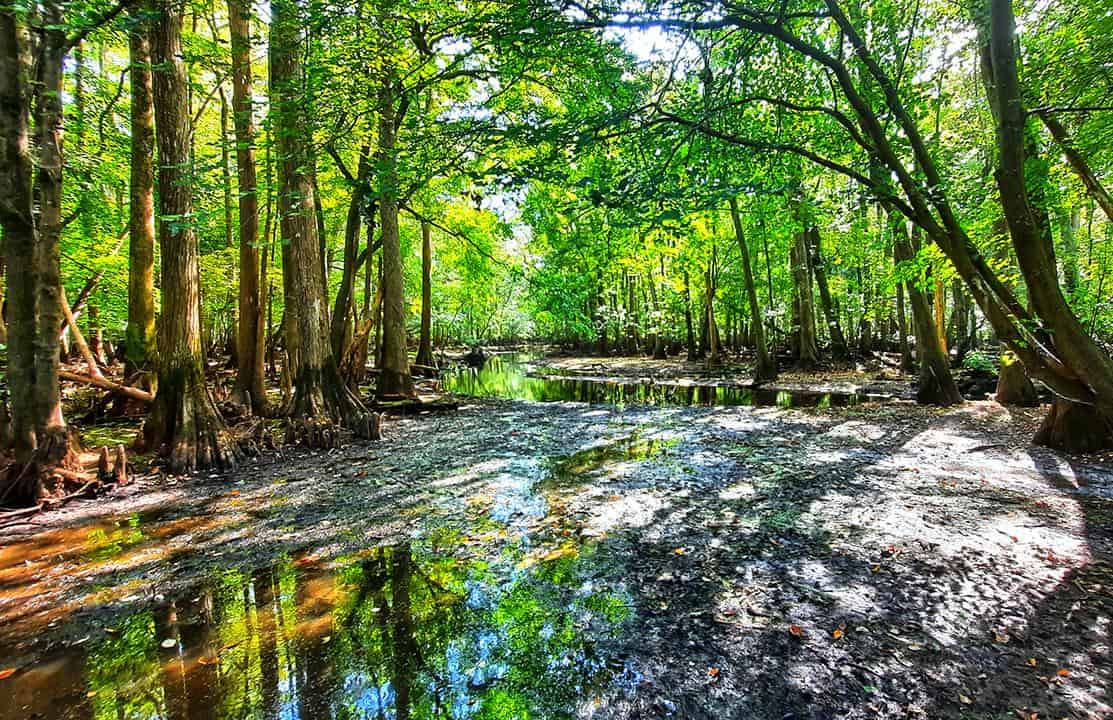
The park contains the largest remaining old-growth bottomland hardwood forest in the United States, where towering deciduous trees thrive in a vast floodplain that is seasonally inundated. Despite frequent misconceptions, Congaree is not a swamp—because its forest floor is not submerged year-round, it does not meet the classification.
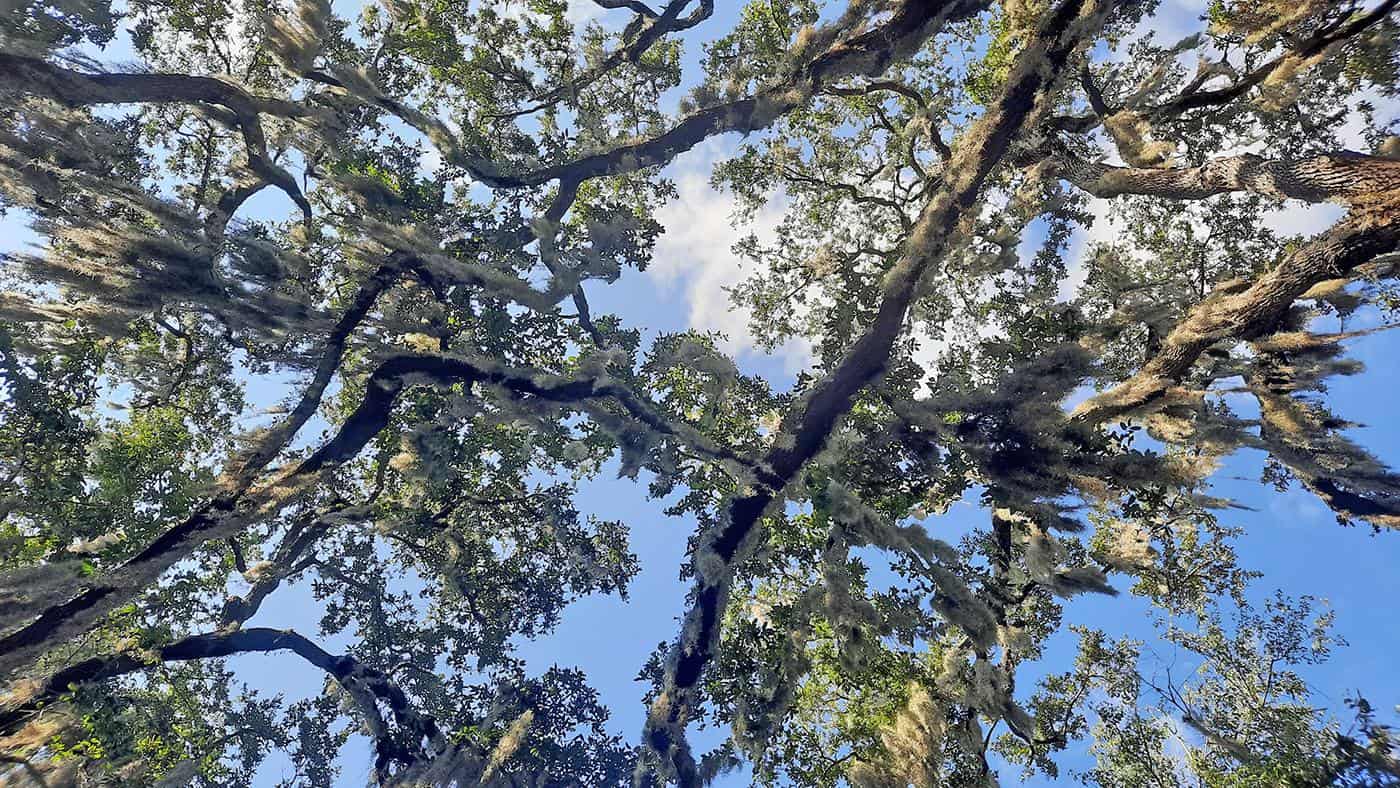
Thanks to abundant water, nutrients, and sunlight, Congaree boasts some of the world’s tallest deciduous trees, with some soaring over 50 meters (164 feet)—taller than a 15-story building. Despite its ecological significance, the park remains one of the least visited in the country, attracting fewer than 150,000 visitors annually, making it an off-the-beaten-path attraction despite its federal status.
As a bottomland hardwood forest, a significant portion of Congaree National Park consists of floodplains, where the ground is periodically submerged under meters of water. Consequently, every plant species that thrives here is not only highly adapted to the wet environment but has also evolved to flourish under these conditions.
More than 75 species of trees populate this ancient woodland, many uniquely suited to tolerate excess water. Perhaps the most striking is the majestic bald cypress, easily recognizable by its distinctive, knee-like roots at the base of the trunk. According to some theories, these structures help stabilize the tree during severe floods. Highly durable and water-resistant, bald cypress wood has long been prized for canoes, cabinetry, roof shingles, and even bridges.
Another dominant tree species is the water tupelo, abundant in the wettest parts of the forest. These trees are easily identified by their swollen trunks, often covered in moss. Also common in the floodplains is the American beech, recognizable by its smooth, gray bark. Indigenous tribes once relied on beech nuts as a food source, grinding them into flour for pastries and bread.
As you walk through the forest, you’ll notice dozens of fallen tree trunks scattered across the ground, often in various stages of decomposition. Though no longer alive, these trees serve as a vital food source for fungi, moss, insects, and, quite ironically, other trees as well. This continuous cycle of life and decay is essential for maintaining the forest’s health, as it replenishes the soil with much-needed nutrients.
Any hike along the park’s trails is accompanied by a symphony of wildlife, though spotting the creatures behind the sounds can be challenging due to the dense vegetation. With a bit of luck, you may encounter feral pigs, coyotes, bobcats, armadillos, otters, and wild turkeys—the latter being particularly vocal.
Among Congaree’s 200 species of birds and 75 species of amphibians and reptiles is a significant number of aquatic animals that inhabit the park’s ponds, creeks, and lakes. Notable residents include common snapping turtles, yellow-bellied sliders, and alligators.
While the park spans vast tracts of land, only a fraction is accessible to the public. Several trails traverse the forest, each with its own distinct character. Situated next to the parking lot, the park’s main entrance leads visitors to the Harry Hampton Visitor Center, where friendly rangers offer essential advice along with free maps and guides detailing the park’s unique ecosystem.
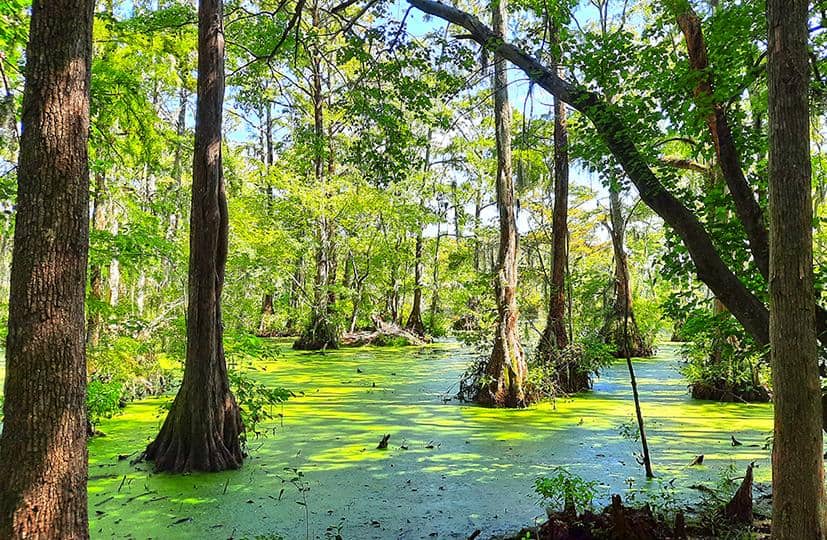
The first trail most visitors take is the 2.4-mile boardwalk, an elevated wooden walkway that stretches a few feet above the forest floor. This path provides a breathtaking glimpse of the park’s floodplains, where a mix of bald cypresses, loblolly pines, and beeches rise dramatically from the swampy waters. The towering canopy creates a cool, shaded environment below, a welcome relief from the scorching sun.
With its flat terrain and multiple benches, the 3.7-kilometer (2.3-mile) loop trail is accessible to nearly everyone and takes about 40 minutes to complete. The boardwalk features several offshoots leading to other trails, as well as a lookout over Weston Lake, a remnant of the ever-shifting Congaree River, which flowed through this area over 2,000 years ago. From the lake’s edge, visitors can often spot freshwater turtles gracefully gliding through the water.
For those seeking a more intense experience, the Weston Lake Loop and Sims Trail offer a wilder adventure, ideal for intrepid hikers. These trails, which intersect with the boardwalk, wind through the dense forest and weave past pockets of murky water. Alternatively, visitors can explore Cedar Creek by kayak, offering a closer and more intimate encounter with the park’s aquatic flora and fauna.
Be aware that Congaree National Park is heavily infested with mosquitoes and other flying insects for most of the year. Applying insect repellent before your visit is essential to minimize this unavoidable nuisance. Additionally, as the park lacks artificial lighting, it is crucial to plan your visit carefully and avoid being caught in the forest after dark.

The elevated wooden walkway provides a glimpse of the park's pristine nature
photography by: Omri Westmark